When Execution Gets Cheap, Identity Becomes the Bottleneck
“Habits are the compound interest of self-improvement.” — James Clear, Atomic Habits
I came back to Atomic Habits this year and Clear’s compounding line hit different than it did the first time I read it.
Back then, the four laws — cue, craving, response, reward — read like a productivity manual. A way to install my flossing habit and reduce social media consumption. Mechanics for getting hard things done. It’s right there in the math. 1.01^365 = 37.78 — becoming 1% better per day, repeated for a year, makes you thirty-eight times the person you were.
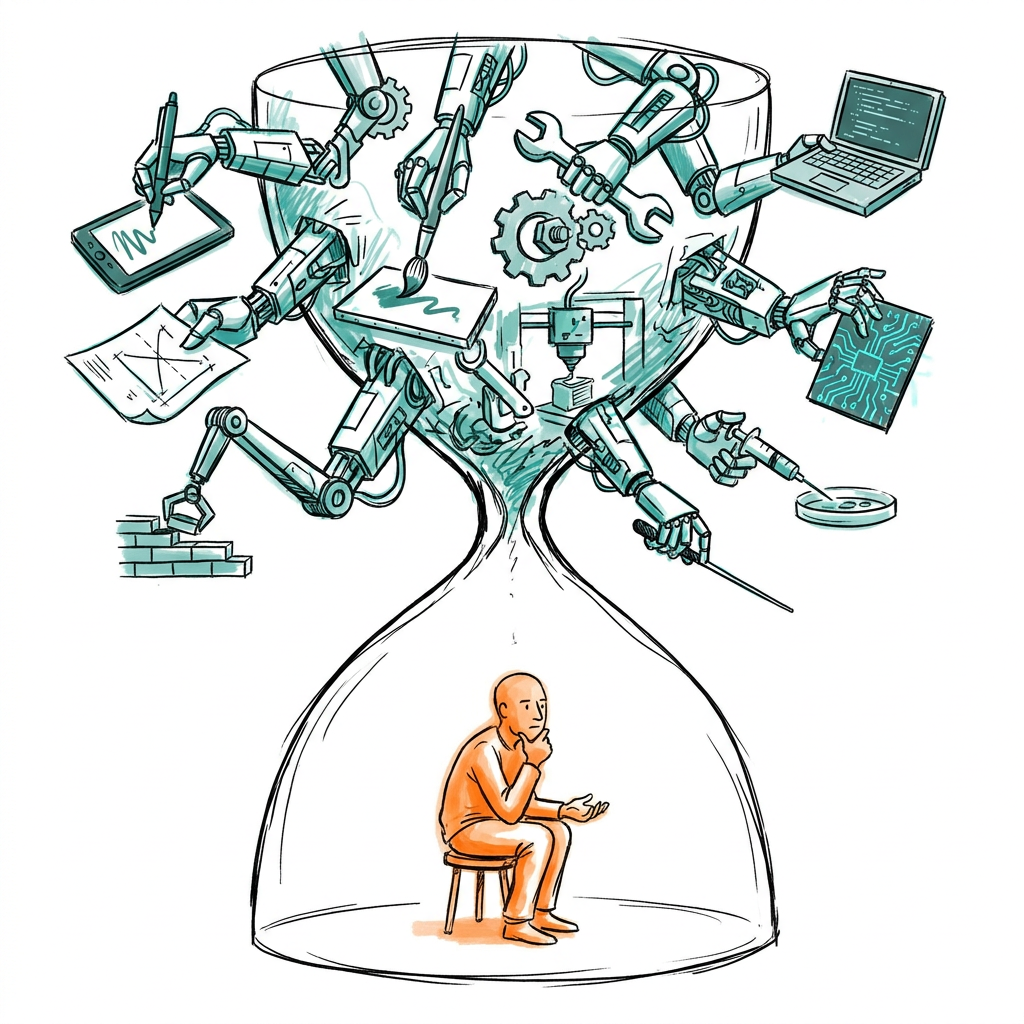
But the world has changed since my last read three years ago. AI writes the code I would have hired for. AI drafts the email I would have sweated over. AI builds the workflow I would have been too busy to build. Execution is no longer the bottleneck.
Reading Atomic Habits now, the four laws stop being a productivity manual. They become a ledger for who you’re becoming.
When execution gets cheap, identity becomes the bottleneck — and every habit is a deposit into the bank of who you are.
I’ll close with one concrete deposit you can cast today. Until then, hold one question in mind: which identity am I compounding?
In 1865, the economist William Stanley Jevons noticed something strange. More efficient steam engines didn’t reduce coal use — they increased it. The efficiency of the steam engine no longer became the bottleneck. As each engine did more work per pound of coal, steam power became economical in places it never had been. Steam boats, railroads and smaller factories all become viable. Demand for engines exploded into what we now call the industrial revolution. More coal was then needed to power all the new steam engines.
We are experiencing a bottleneck shift right now.
AI has made execution cheap. For $20/month anyone can get a world class developer, research scientist, author, and business executive all rolled up into a single package. It’s no longer about, can I draft the business plan, or can I write the code to get my website onto the internet. The bottleneck has moved, and it’s landing on judgment.
Your judgment, or ability to make considered decisions, is exactly who you are as a person. Every choice you make from which project deserves my time, and which trade-off is worth taking, to what clothes do I wear and how do I style my hair. String enough of these decisions together and you have your identity.
If we had to make a conscious decision about everything we do all day, our brain would melt. Given our conscious processing constraints, the brain runs on autopilot most of the day. How we tie our shoes, the route you drive, and which headphone you put in first. A subconscious decision is just another name for a habit.
That’s what Clear is actually pointing at. Habits aren’t life hacks. They’re the operating system of your identity. The votes you cast without thinking, that keep building the person who casts them. You do not rise to the level of your goals. You fall to the level of your systems.
My yearly themes are how I build those systems. 2024 was Manufacture Opportunities — the system was: put yourself in rooms where good things happen. 2025 was High Agency — the system was: when something needs doing, you do it. 2026 is Scale Your Compute — the system is: what steps can I build to run without me? Each theme isn’t a goal I’m chasing. It’s an identity I’m voting for, and the habits fall out of it.
When the identity and the habits and the systems all point the same direction, the math stops being additive and starts being exponential. Each habit doesn’t just deposit one rep — it confirms the identity that selects the next habit, which strengthens the system that supplies the next cue. That’s why 1.01^365 = 37.78 isn’t a math trick. It’s what happens when you stop running disconnected habits and start being a coherent person.
Clear breaks habits into four laws — cue, craving, response, reward. Make it obvious. Make it attractive. Make it easy. Make it satisfying. The first time I read the book, I treated these as a checklist for getting hard things done. Tape your shoes to the door. Pair the run with a podcast. Track the streak.
Reading it now, I see that the four laws aren’t a checklist, they’re four levers on the same loop. A loop that turns who you want to be into who you actually are.
The cue is the part that hides in plain sight. When Jack Dorsey took over Twitter, everyone told him to hire a coach. He hired one. Learned nothing. So he flipped it. Every person, every encounter, every problem became a mentor — if he decided to learn from it (he tells the story here). He started writing down one lesson per interaction, daily. The conversations he was already having didn’t change. What changed was that he decided they were teaching him. The cue is always there. Whether it triggers a habit depends on whether you’ve decided you’re the kind of person who notices it.
Craving is the part most people get wrong. Jevons saw it in coal. Cheaper steam power didn’t make people content with the engines they had — it made them want engines in more places. The more you have, the more you want. This is why Clear’s make it attractive is a load-bearing law of the loop, not a marketing tip. Craving isn’t a personal failing. It’s how the system grows. The more positive reps you cast for an identity, the more reps that identity wants to cast. The loop feeds itself.
Response is what separates motion from action. When you’re in motion, you’re planning. When you’re taking action, you’re doing the thing. Twenty articles outlined is motion. One article written is action. Three diet books read is motion. One healthy meal eaten is action. Motion feels productive because it looks like the activity, but it doesn’t move you in the world. Only action votes for the identity. The most effective form of learning is practice, not planning.
Reward is what makes the loop stick. The brain doesn’t notice the delayed payoff. The Cardinal Rule of Behavior Change: What is immediately rewarded is repeated. Willpower and motivation last a couple days, maybe a week — then they break down. They run on effort, and effort runs out.
Rewards work because they bypass the willpower system entirely. They route through a different pathway, the dopamine system. This system doesn’t need conscious effort to run. The part that usually trips people up, is that dopamine doesn’t fire when you get the reward. It fires when you anticipate it. Once your brain has learned that a cue predicts a reward, the cue itself triggers the wanting. Like tying your shoe, willpower never has to show up.
These are four positions on the same loop, and each one folds back into identity. The cue you notice because of who you’ve decided you are. The craving that grows because the identity has appetite. The action that votes because planning isn’t enough. The reward that confirms because the rep felt like you.
Each loop tightens the identity that runs the next loop. That’s why habits compound.
So here’s the deposit.
Right now, sit down and write out every habit you can name. Big ones, small ones. The morning routine, the way you open your phone, the snacks, the bedtime ritual. Don’t judge them yet — just see them. Clear calls this the Habits Scorecard, and he runs it as the first exercise in the book because the cue law — make it obvious — doesn’t work on habits that are still invisible to you.
Now you have an answer to the question I left you with at the top — which identity am I compounding? — that isn’t a story. It’s a list. Some entries are deposits in the identity you want. Some are withdrawals from it. The current state is the only place the transition can start. And once you can see the votes you’re already casting, you can choose what to cast tomorrow.